
Can you help with a dog that pulls on the lead?
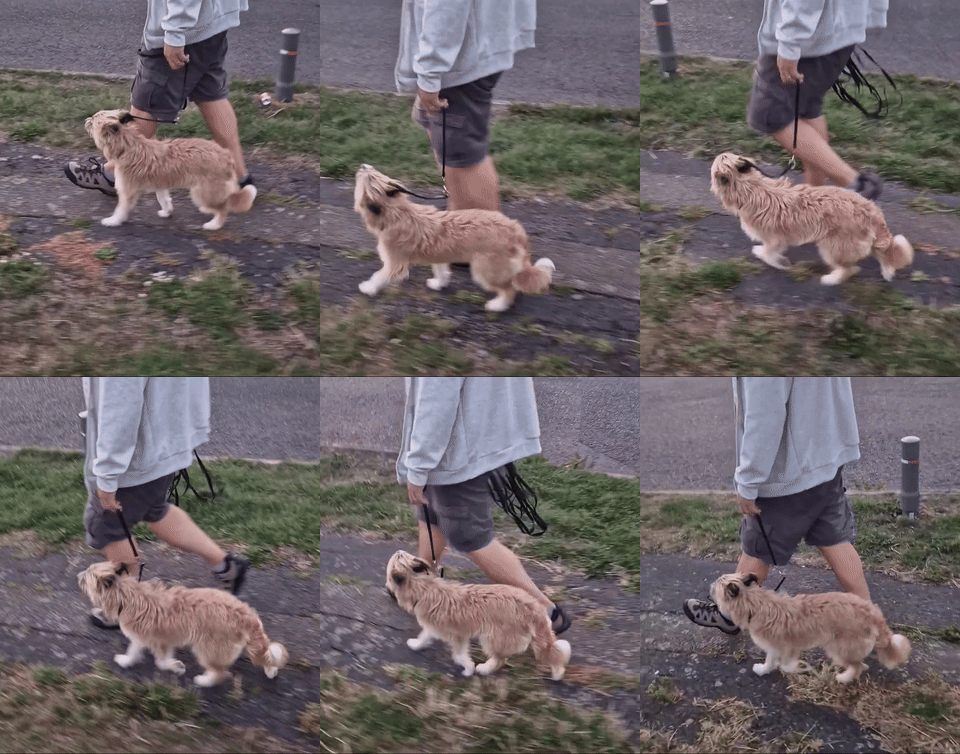
Yes. Loose lead walking is one of the most common problems I work with. I'll teach your dog how to walk with you rather than constantly pulling ahead, while also teaching you how to communicate clearly and consistently with your dog.
The aim is a calm, enjoyable walk where you and your dog are working together.
Can you train a reactive dog?
Yes. I work with dogs that bark, lunge, pull or become difficult to control around other dogs, people or other distractions.
We'll look at why the behaviour is happening and then work on changing how your dog responds, while giving you the skills and confidence to manage situations correctly.
Can you help with recall?
Absolutely. Reliable recall isn't simply about teaching your dog the word "come".
I'll help you build a stronger response to your communication, gradually introduce distractions and teach your dog that returning to you is worthwhile.
Why does my dog listen at home but not outside?
Because the environment changes everything.
Your dog may understand a command in the quiet of your home
but struggle when there are smells, people, dogs and other distractions around.
Training needs to gradually progress from low-distraction environments into real-life situations so your dog learns to listen wherever you are.
Can you help my dog stop jumping up at people?
Yes. Jumping up is often accidentally rewarded because the dog gets attention when it does it.
I'll show you how to communicate clearly with your dog and reinforce the behaviour you actually want instead.
Can you help with barking?
Yes, but there isn't one solution that works for every barking problem.
We first need to understand why your dog is barking. A dog barking from excitement requires a different approach to a dog barking because it is anxious, frustrated or reacting to something in its environment.
Can you teach my dog to settle?
Yes. Learning to switch off is an important part of having a well-balanced dog.
I'll teach you practical exercises that help your dog understand when it's time to engage with you and when it's time to relax.
Do I have to use treats forever?
No.
Treats can be a useful training tool, particularly when teaching something new, but I don't want your dog to only listen when food is available.
The aim is to build understanding, communication and a strong relationship between you and your dog so that treats aren't needed for every interaction.
Will you train my dog for me?
My goal isn't simply to make your dog behave while I'm holding the lead.
I want to teach you how to communicate with your dog so the changes continue when I'm no longer there.
You are an important part of your dog's training, and I'll show you what to do and why it works.
My dog has serious behavioural problems. Can you help?
Yes, absolutely. Serious behavioural problems can often be improved with the right training, consistency and understanding of what is driving the behaviour.
I'll take the time to assess your dog, understand what is happening and identify where we need to start. Whether you're dealing with reactivity, aggression, anxiety, poor impulse control, lead issues or other challenging behaviours, I'll give you practical guidance and work with you to make meaningful changes.
Every dog and situation is different, so I won't make unrealistic promises or claim there is a quick fix. I'll always be honest about what I believe can be achieved and support you throughout the process.
What training methods do you use?
I use the methods and tools I believe are appropriate for the individual dog and the behaviour we're working on.
My focus is on clear communication, consistency, structure and achieving reliable results while maintaining a strong relationship between dog and owner.
Do you use treats in your training?
Sometimes. Food can be an excellent training tool when used correctly.
However, training isn't simply about bribing a dog with treats. I concentrate heavily on communication, engagement, structure and the relationship between you and your dog.
Is it too late to train an older dog?
No.
Dogs can learn throughout their lives. Older dogs may have had more time to practise unwanted behaviours, but with consistency, clear communication and the right approach, meaningful changes can still be made.
Can you train a rescue dog?
Yes.
Rescue dogs can sometimes arrive with habits, fears or behaviours that their new owners weren't expecting.
Training needs to take into account the individual dog and its history rather than assuming every rescue dog needs the same approach.
Why is the relationship between me and my dog so important?
Because training isn't just about commands.
I want your dog to see you as the person it looks to for guidance, direction and reassurance.
The stronger your communication becomes, the easier it is to influence your dog's behaviour in everyday situations.
My dog knows lots of commands but still misbehaves. Why?
Knowing commands isn't the same as understanding how to behave.
A dog can know "sit", "down" and "stay" and still pull on the lead, ignore its owner or react to other dogs.
Good training needs to carry over into everyday life, not just work when you're standing in the kitchen with a bag of treats.
Why does my dog behave differently for me than for other people?
Dogs quickly learn what they can and can't get away with depending on who they're with.
If one person is consistent and another isn't, your dog receives conflicting information.
Everyone in the household needs to understand the same expectations and communicate with the dog consistently.
What age should I start training my dog?
Training can start from the moment your dog comes home.
Puppies benefit from learning good habits early, but older dogs can learn new behaviours too.
The important thing is teaching the right habits before unwanted behaviours become established.
How much exercise does my dog need?
It depends on the individual dog, but exercise isn't always the answer to behavioural problems.
A dog can be physically exhausted and still struggle to settle or listen.
Mental stimulation, structure, training and learning how to switch off are also important parts of a well-balanced dog.
What happens during the first training session?
The first session is about understanding you, your dog and the problems you're experiencing.
We'll discuss your routine and goals, look at the behaviour you're struggling with and start working on practical exercises straight away.
You'll leave with a better understanding of your dog and what you need to do going forward.
Can't find the answer you're looking for?
Every dog is different, and you may have a problem that isn't covered here.
If you're struggling with your dog's behaviour and aren't sure whether I can help, get in touch and tell me what's happening.
I'll be honest about whether I believe I can help and what the best next step would be.
Dog Training Advice
Every dog is different, and so is every owner. Here are some of the questions I'm asked most often about dog training and behaviour.


Phone:
Email:
© 2026. All rights reserved.